For generations of New Orleans residents, grocery shopping was more than a weekly necessity. It was part of the rhythm of neighborhood life, where familiar stores served families, employees knew their customers, and local businesses became part of a community's identity. Among the names that once occupied a prominent place in the New Orleans grocery industry was Canal Villere, a supermarket chain remembered by many who grew up shopping in southeastern Louisiana.
The history of Canal Villere reaches back to an era when neighborhood grocery stores were essential to everyday life. During the early twentieth century, New Orleans was home to numerous independent grocers, family-operated markets, and growing regional chains. The Canal Villere name was already appearing in local grocery directories by the 1930s, reflecting a period when the grocery industry was beginning to move away from small, counter-service establishments toward larger, more modern retail operations. As consumer habits changed, grocery stores increasingly offered shoppers the convenience of selecting their own merchandise from organized aisles rather than relying entirely on clerks behind a counter.
As New Orleans expanded beyond its traditional neighborhoods, the grocery business followed. The growth of suburbs such as Metairie and Kenner, along with residential development in New Orleans East and communities along the Mississippi River, created new opportunities for supermarket operators. Canal Villere became a recognizable presence in these growing communities, with stores offering groceries, household necessities, fresh produce, and other everyday merchandise. Its expansion reflected a larger transformation in Louisiana, as shopping gradually shifted from small neighborhood markets to supermarkets with parking lots, wider selections, and convenient locations along major thoroughfares.
Canal Villere's development was also connected to the National Tea Company, a major American grocery corporation that operated supermarkets under several regional names. Through its relationship with National and affiliated businesses, the Canal Villere name became part of a larger retail organization while retaining a familiar identity in the New Orleans market. During the latter decades of the twentieth century, shoppers encountered stores operating under the National and Canal Villere names, illustrating how national grocery corporations often maintained established regional identities to preserve customer recognition.
By the 1970s and 1980s, Canal Villere supermarkets were part of the commercial landscape of metropolitan New Orleans. Locations could be found in established neighborhoods and expanding suburban communities, including Metairie, Kenner, River Ridge, Chalmette, and New Orleans East. These stores served a region undergoing significant changes in population, transportation, and shopping habits. For many households, a trip to Canal Villere was simply part of ordinary life, whether purchasing ingredients for a Sunday dinner, preparing for a holiday gathering, or completing the family's weekly grocery shopping.
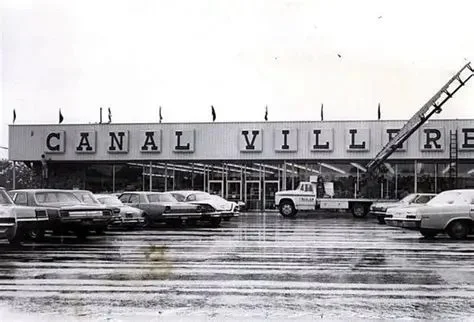
Canal Villere Supermarket, circa 1970s. A nostalgic glimpse of a once-familiar grocery chain that served generations of New Orleans-area shoppers.
Yet the supermarket industry was becoming increasingly competitive. Regional operators faced pressure from larger chains, changing consumer expectations, rising operating expenses, and the continued expansion of discount grocery retailers. In southeastern Louisiana, competition was especially intense, with established businesses such as Schwegmann Brothers, Winn-Dixie, and other supermarket operators competing for customers. Price, convenience, store size, and location increasingly determined which businesses survived in a changing marketplace.
A major turning point came in 1995, when Schwegmann Giant Super Markets acquired 28 supermarkets from National in Louisiana, Mississippi, and Alabama. The transaction included stores operating under several names, including Canal Villere. The acquisition represented another stage in the consolidation of the regional grocery industry, as familiar supermarket brands were absorbed into competing operations. For Canal Villere, the transaction effectively marked the beginning of the end of its identity as a recognizable grocery chain in the New Orleans market.
During the years that followed, the Canal Villere name gradually disappeared from storefronts. Some locations changed ownership or were converted to other supermarket identities, while others eventually closed. Schwegmann, once one of the region's most influential grocery businesses, also experienced serious financial difficulties and entered bankruptcy in 1999. Within a relatively short period, two names that had been deeply connected to grocery shopping in southeastern Louisiana had largely vanished from the retail landscape.
The disappearance of Canal Villere was part of a broader transformation affecting grocery stores throughout Louisiana. As independent markets and regional supermarket chains struggled against corporate consolidation and changing shopping patterns, many familiar businesses disappeared. Their former buildings were remodeled, repurposed, or demolished, leaving behind little visible evidence of the stores that once served surrounding neighborhoods. Yet their names continued to survive in family conversations, old newspaper advertisements, photographs, and the memories of former customers and employees.
Today, Canal Villere occupies a place in the commercial history of New Orleans and its surrounding communities. Its story reflects the evolution of grocery shopping, the expansion of suburban Louisiana, and the economic forces that reshaped the region's retail industry. Although the chain no longer exists, it remains part of a generation's memories of neighborhood life and the businesses that once defined familiar streets and shopping centers.
The history of Louisiana is not written only through its political leaders, historic buildings, or major events. It is also found in the ordinary places where people worked, shopped, and gathered. Canal Villere was one of those places. Its disappearance reminds us that even the most familiar businesses can eventually become part of history, leaving behind a legacy preserved not in their storefronts, but in the memories of the communities they once served.
Federal Trade Commission. “Schwegmann Giant Super Markets, Inc.” Federal Trade Commission, June 1995, https://www.ftc.gov/news-events/news/press-releases/1995/06/schwegmann-giant-super-markets-inc.“New Orleans Area Chain Grocery/Supermarket Locations, 1925–2015.” Groceteria.com, https://www.groceteria.com/place/us-louisiana/new-orleans/. Accessed 15 Oct. 2026.“Schwegmann Brand Enters Ex-National Tea Co. Stores.” Supermarket News, 22 Jan. 1996, https://www.supermarketnews.com/grocery-operations/schwegmann-brand-enters-ex-national-tea-co-stores.“Schwegmann in Chapter 11; Plans to Sell All 24 Units.” Supermarket News, https://www.supermarketnews.com/grocery-operations/schwegmann-in-chapter-11-plans-to-sell-all-24-units. Accessed 15 Oct. 2026.