New Orleans has always been a city where history and mystery exist side by side. Its centuries-old cemeteries, historic architecture, narrow streets, and supernatural legends create an atmosphere unlike anywhere else in Louisiana. When October arrives, the city embraces Halloween with a celebration combining folklore, elaborate costumes, music, and traditions that reflect its distinctive cultural identity.
Long before Halloween became a popular celebration, New Orleans had developed a reputation for ghost stories, spiritual traditions, and mysterious occurrences. Founded by the French in 1718, the city became a cultural crossroads shaped by European, African, Caribbean, and American influences. Its Catholic heritage introduced traditions surrounding All Saints' Day and All Souls' Day, when families visited cemeteries, decorated graves, and remembered deceased relatives. Although separate from Halloween, these observances helped establish a lasting cultural connection between the living and the dead.
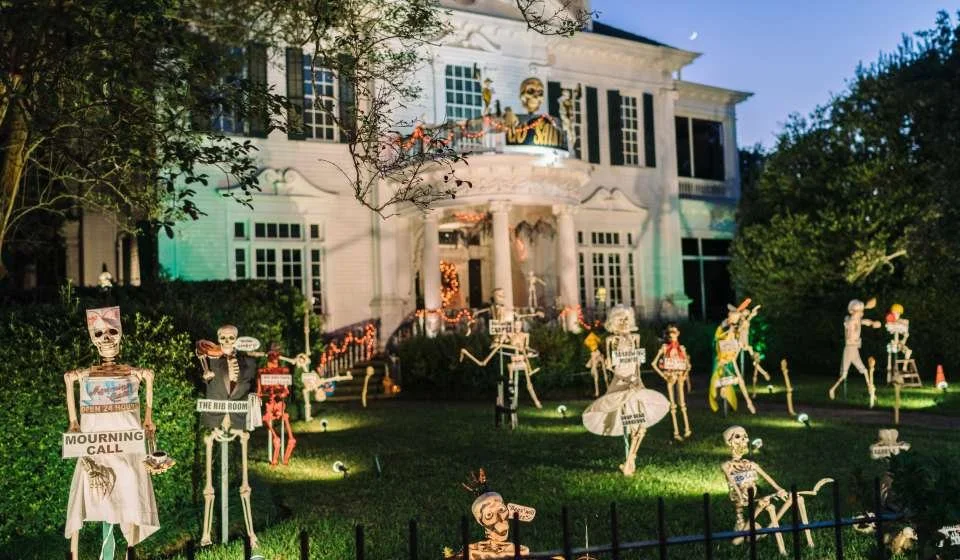
An elaborately decorated New Orleans residence celebrates Halloween with illuminated skeletons, playful graveyard humor, and theatrical displays. The scene reflects the city's distinctive approach to Halloween, where creativity, spectacle, and neighborhood traditions bring the holiday to life.
Louisiana Voodoo also contributed to the city's spiritual history. Rooted in African religious traditions and influenced by Catholicism and Caribbean practices, Voodoo became an important part of New Orleans' cultural identity. While popular entertainment often portrays these traditions as frightening or mysterious, their historical significance extends to spirituality, healing, protection, and honoring ancestors.
Few places capture New Orleans' mysterious reputation more vividly than its historic cemeteries. Above-ground tombs, weathered monuments, and elaborate burial structures have become recognizable symbols of the city. St. Louis Cemetery No. 1 and Lafayette Cemetery No. 1 preserve generations of history, while legends surrounding Marie Laveau, the famous nineteenth-century Voodoo practitioner, continue to fascinate visitors. Throughout the French Quarter, stories of haunted buildings, unexplained encounters, and restless spirits have become part of local folklore. The LaLaurie Mansion on Royal Street, associated with the documented abuse of enslaved people, remains one of the city's most infamous historic properties and the subject of numerous supernatural legends.
As Halloween gained popularity across America during the twentieth century, New Orleans developed its own interpretation of the holiday. The city's longstanding traditions of masquerade, theatrical performance, and public celebration made Halloween a natural addition to its cultural calendar. The French Quarter became a gathering place for elaborate costumes, street entertainment, and nighttime festivities, while Bourbon Street attracted crowds celebrating in a style reminiscent of Mardi Gras.
Halloween also became an important occasion for local musicians, artists, performers, and businesses. Haunted attractions, ghost tours, themed concerts, and neighborhood celebrations transformed the holiday into a significant cultural and tourism event. One of the city's most recognizable traditions is the Krewe of BOO!, established in 2007, which brings Halloween to the streets through decorated floats, elaborate costumes, and a parade atmosphere inspired by New Orleans' famous Carnival celebrations.
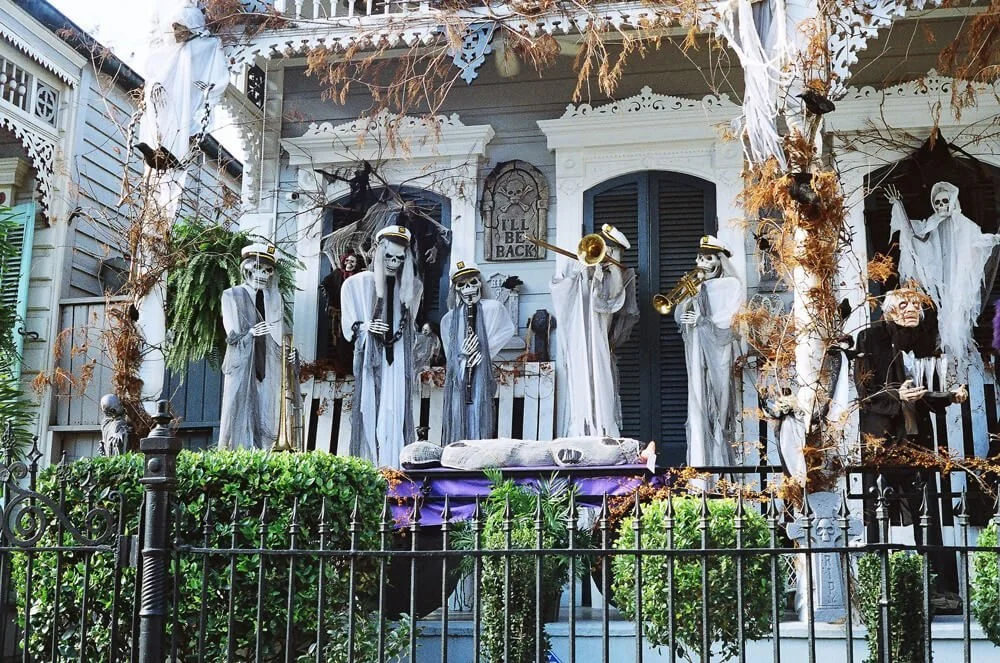
A historic New Orleans home comes alive with ghostly musicians, skeletons, and elaborate Halloween decorations, reflecting the city's unique blend of creativity, mystery, and tradition.
The city's historic architecture provides a dramatic backdrop for these festivities. French Quarter courtyards, centuries-old buildings, and Garden District mansions have inspired generations of ghost stories. Although many supernatural claims cannot be historically verified, they often draw attention to genuine people, events, and locations. New Orleans' history of colonial settlement, slavery, epidemics, immigration, and religious traditions is far more complex than the legends that surround it.
Today, Halloween remains one of New Orleans' most distinctive seasonal celebrations. Residents decorate their homes, families participate in neighborhood festivities, and visitors gather throughout the city to experience its unusual combination of history, entertainment, and folklore. Beneath the costumes and ghost stories lies a deeper connection to a city that has never entirely separated its past from its present.
Halloween in New Orleans is more than a celebration of the supernatural. It is an expression of the city's history, creativity, and cultural traditions. In a place where nearly every street has a story, the most haunting experiences are not always found in ghostly legends, but in the remarkable history that continues to surround us.
Eschner, Kat. “Voodoo Priestess Marie Laveau Created New Orleans’ Midsummer Festival.” Smithsonian Magazine, 23 June 2017, https://www.smithsonianmag.com/smart-news/voodoo-priestess-marie-laveau-created-new-orleans-midsummer-festival-180963750/.Krewe of BOO! “About.” Krewe of BOO!, https://www.kreweofboo.com/about. Accessed 17 Oct. 2026.Louisiana State Museum. “Mystery in Motion: Louisiana Voodoo.” Louisiana State Museum, https://louisianastatemuseum.org/mystery-motion-louisiana-voodoo. Accessed 17 Oct. 2026.National Park Service. “New Marigny Historic District, New Orleans, Orleans Parish, LA.” National Register of Historic Places, U.S. Department of the Interior, https://npgallery.nps.gov/GetAsset/e0d5f3eb-5dd4-4959-a8a1-1d36410f6da2. Accessed 17 Oct. 2026.New Orleans & Company. “Day of the Dead.” NewOrleans.com, https://www.neworleans.com/events/holidays-seasonal/day-of-the-dead/. Accessed 17 Oct. 2026.Tucker, Abigail. “The New Orleans Historic Voodoo Museum.” Smithsonian Magazine, June 2011, https://www.smithsonianmag.com/arts-culture/the-new-orleans-historic-voodoo-museum-160505840/